Bright Indirect Light: Find the Right Spot by Your Window
Find bright indirect light at home with a window-by-window guide, a placement diagram, and a copyable checklist for sun, shade, and seasonal changes.

In this guide
Bright indirect light is strong daylight reaching a plant without an unobstructed sunbeam falling on its leaves. To find it, check the spot where the leaves will sit, note when direct sun reaches it, and account for anything shading the window. A window’s direction helps you choose where to look; it does not guarantee that a particular shelf has enough light.
This guide is for choosing a location indoors in a U.S. home. Use it alongside care guidance for your plant’s identified species, since a light label alone does not tell you how much sun that plant can tolerate.
Check the plant’s spot, not the whole room
Start with the place you want to put the pot. Look at it in the morning, around midday, and later in the afternoon. These are observation checkpoints, not a prescribed number of hours of light. Write down whether a sunbeam reaches the leaf position and whether curtains or blinds are normally open then.
Treat “direct” and “bright” as separate questions. A spot can be outside a sunbeam yet receive too little daylight. It can also receive direct sun for part of the day and indirect light afterward. Describe both conditions instead of assigning the entire room one label.
The University of Maryland’s lighting guide explains that light intensity and duration both matter. Distance, trees, neighboring buildings, window materials, and curtains also affect the light reaching a plant. Include those details in your notes; “living room window” leaves out most of the information you need.
Start with your window’s direction
Find the direction the window faces outward, using a compass if needed. The patterns below are starting points for windows in the United States, not a substitute for observing your particular location.
| Window faces | Starting expectation | What to check at leaf height |
|---|---|---|
| North | Generally lower light. | Whether the opening is large and unobstructed enough for the plant’s needs. |
| East | Often a candidate for medium-light plants. | Whether morning sun reaches the leaves before the spot becomes indirect. |
| South | Generally the strongest, longest exposure. | The sunbeam’s path and whether a nearby position outside it stays well lit. |
| West | Can suit medium- or higher-light plants. | Afternoon exposure and whether a sheer curtain is needed for a sensitive plant. |
These patterns follow the University of Missouri’s window guidance. A roof overhang or neighboring building can change the result. Check the actual view through the window before deciding that a south-facing room must be bright.
Do not move every plant to the brightest available windowsill. Match the species to the conditions you observed, including any direct sun. If the label is vague, find species-specific care guidance before choosing a permanent spot.
Map the sunbeam and the obstacles
Use this placement map as a schematic, not a scale drawing. A and B are possible observation locations; neither is automatically suitable for every plant.
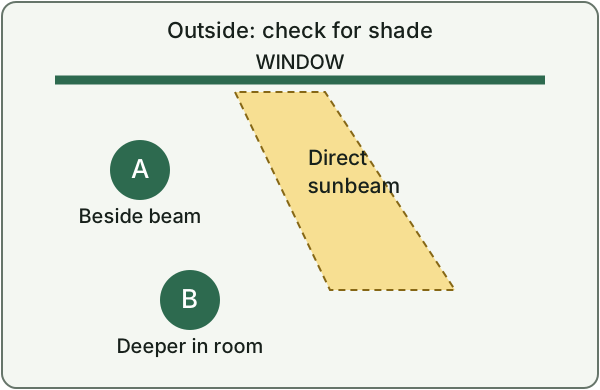
The sunbeam moves, so a position beside it during one check may be inside it later. On your own sketch, mark the window, the proposed pot location, and the beam at each observation. Add a note for obstacles outside and for blinds you actually use.
If direct sun is excessive for your plant, consider a nearby position outside the beam or a sheer curtain. Maryland Extension recommends light shading or increased distance to protect plants from excessive summer sun. Reassess after either change: filtering light and moving farther away also change how much light reaches the leaves.
Check intensity before making the choice
If you can identify sunbeams but cannot tell whether the remaining light is sufficient, measure it. Missouri Extension notes that eyes adjust to brightness and recommends treating light-meter readings as a guide.
- Find care guidance for your identified species. Record its light recommendation and any limits on direct sun. If it gives only a label, use a university extension reference to interpret that category; do not assume that all “bright indirect” labels specify the same intensity.
- Use a meter that reports foot-candles (fc), following its instructions. Place the sensor where the leaves will be, without shading it with your body. Keep curtains and blinds in their usual positions.
- Record the location, time, weather, reading, and whether direct sun reaches that position. Repeat at your morning, midday, and afternoon checkpoints so a single reading does not stand in for the whole day.
- Compare the records with the care guidance. A location consistently below its recommended range needs another assessment or supplemental light; a location receiving unwanted direct sun needs a placement or shading change. Recheck after the change.
For context, Missouri Extension gives 250–1,000 fc as a general range for medium-light plants. This is a category reference, not a universal definition of bright indirect light or a target for every species. Spot readings also do not establish total daily light exposure. If the species guidance and your observations do not support a choice, mark it “not yet determined.”
Hypothetical completed comparison: an apartment has a south-facing window beneath a porch roof. The owner is comparing a desk beside the window (A) with a bookcase deeper inside (B) for a plant whose care guidance calls for medium light. These invented readings demonstrate recordkeeping; they are not results from a real home.
| Check | Desk A | Bookcase B |
|---|---|---|
| Morning, overcast | 300 fc; no beam on leaves | 60 fc; no beam on leaves |
| Midday, overcast | 450 fc; no beam on leaves | 90 fc; no beam on leaves |
| Afternoon, overcast | 280 fc; no beam on leaves | 50 fc; no beam on leaves |
Recorded decision: assess A further; do not choose B based on this record. A falls within Missouri’s general medium-light range at these checkpoints, while B is below it. Before treating A as the permanent location, confirm the identified species’ needs and repeat the sunbeam check on a clear day. An overcast-day record cannot rule out direct sun on a sunny day.
Copy this window assessment
Use a separate record for each proposed location. Copy the worksheet into a note or print it, then fill it in while looking at the spot. Leave an entry marked “not checked” rather than guessing what happens while you are away.
Window light assessment
Plant and species: ____________________
Window direction and proposed location: ____________________
Date and weather: ____________________
| Check | Observation | Decision or next check |
|---|---|---|
| Morning | Sun on leaves? Blinds open? | ____________________ |
| Midday | Sun on leaves? Outside shade? | ____________________ |
| Afternoon | Sun on leaves? Curtain in use? | ____________________ |
| Obstacles | Roof, tree, building, furniture? | ____________________ |
| Species guidance | Light category or range; direct-sun limits; source? | ____________________ |
| Meter readings | Time, weather, fc, and location? | ____________________ |
Choose: keep this spot / compare another spot / measure light / consider a grow light.
Reason for that choice: ____________________
Recheck after: seasonal change / curtain change / furniture move / other: ____________________.
For a useful comparison, describe locations precisely: “desk beside the window” and “top shelf behind the couch.” If you take meter readings, record the units and time beside each location. The worksheet is an original planning tool, not a measured light rating or a guarantee of plant growth.
Check pet safety before choosing the location
Check pet safety separately when choosing a plant and its location. This lighting guide does not assess toxicity. Identify the species and check its safety for cats and dogs before settling on a spot; a location with suitable light may still be accessible to a pet. Use the species’ care and safety guidance alongside this assessment.
Recheck when the conditions change
A location does not keep the same light throughout the year. Missouri Extension notes that south-window exposure can help in winter yet be excessive for sensitive plants during brighter seasons. Revisit your sketch when you notice a different sunbeam path or a change in outdoor shade.
Repeat the assessment after changing curtains or moving the pot to another shelf. Keep the old record so you can compare the conditions rather than relying on how bright the room felt months ago.
Also reassess watering after a light change. Minnesota Extension notes that plants in lower light grow more slowly and use less water. Check the potting mix according to the species’ needs instead of preserving a fixed watering calendar.
When the location isn’t working
| What you notice | What to check next |
|---|---|
| Long, thin stems with wider gaps between leaves. | Compare the location with the species’ light requirements. |
| Bleached or scorched foliage. | Check for excessive exposure, including sun that reaches the plant while you are away. |
| The room feels bright, but the plant is tucked behind furniture. | Assess light at the leaves rather than from the doorway. |
| No promising window location matches the plant. | Consider supplemental lighting or a plant suited to the available conditions. |
Minnesota Extension describes stretched growth as a possible sign of too little light and scorched or bleached leaves as a possible result of too much. These observations guide a light check; they do not establish the cause of every damaged leaf. Use species-specific guidance before changing other parts of care.
Questions to settle before choosing a spot
How far from a window is bright indirect light?
There is no distance that works for every window. A large, clear opening and a small shaded window create different conditions at the same distance. Missouri Extension advises considering window size and outside shade; compare your proposed locations instead of using a fixed number of feet.
Which direction is best for bright indirect light?
Choose the window that gives your plant adequate light with manageable direct exposure. Direction narrows your options, but the placement map and observation record decide between them. An orientation label cannot account for a building directly outside the glass.
Where should I put plants for bright indirect light?
Start by assessing an accessible location near a window, then compare it with the plant’s care requirements. If observation leaves you unsure about intensity, use a light meter that reports foot-candles and consult suitable species guidance. Missouri Extension cautions that eyes adjust to brightness, making visual judgments unreliable.
Finish by naming one location and the evidence for choosing it. Keep the completed record with your plant-care notes so the next seasonal check starts from observations you already made.
Sources
- Lighting for indoor plants and starting seeds, University of Minnesota Extension. Accessed November 8, 2026.
Supports: Match plants to available light; overhangs; signs of insufficient or excessive light; lower light reduces water use.
- Lighting for Indoor Plants, University of Maryland Extension. Accessed November 8, 2026.
Supports: Intensity and duration; distance, obstructions, seasons, and window characteristics; sheer curtains; supplemental lighting.
- Lighting Indoor Houseplants, University of Missouri Extension. Accessed November 8, 2026.
Supports: Window orientation and size; seasonal exposure; limits of judging light by eye; foot-candle meters.