How to Organize a Small Closet, One Section at a Time
Organize a small clothes closet with a section-by-section worksheet, a sample layout, and an access test before buying bins or changing shelves and rods.

Quick answer
Choose one shelf or section of hanging clothes, give its contents a temporary landing spot, and put the keepers back before opening another section. Measure the usable space and test access before buying organizers.
In this guide
- Choose a section you can put back before stopping
- Measure access, not just the empty rectangle
- Assign clothes by how you use them
- Copy a worksheet for the section you are opening
- Choose between rearranging and installing storage
- Close the section with an access test
- When the arrangement isn’t working
- Questions about small closets
- Sources
To organize a small closet, start with one shelf or a short section of hanging clothes, then return its keepers before opening another section. Give frequently worn pieces the spots you can reach and see. Measure the space that remains, including door obstructions, before buying bins or changing rods.
This plan is for a clothes closet, including a shallow reach-in, a narrow closet, or a shared wardrobe. You can use it without taking everything out at once. The worksheet below records what fits, what blocks access, and what still needs a decision.
Choose a section you can put back before stopping
Pick a visible boundary: the shoes beneath one door opening, a shelf, or the shirts between two dividers. Leave the rest of the closet in service. The American Cleaning Institute recommends working in manageable areas and measuring before buying storage.
Choose a temporary landing spot large enough for that section alone. A clear bed corner or an empty laundry basket can work; if you need the bed soon, choose somewhere else. Leave the doorway and the route through the bedroom clear. If your landing spot fills up, stop removing clothes and start putting them back.
Separate items into keep here, move elsewhere, and decision pending. Add an outgoing bag only for items whose owner has agreed to let them go. A repair, a seasonal need, or a change in fit can justify keeping something; you do not need a universal discard deadline.
If the empty shelf needs cleaning, use a product suitable for its surface and follow the label. CDC guidance says regular cleaning is sufficient in most situations. Do not mix products. If using a disinfectant, follow its ventilation directions, and keep cleaning chemicals out of reach of children and pets. Return clothes only after the surface is dry.
Measure access, not just the empty rectangle
Record the usable width, depth, and height of your chosen section in inches. Then measure the actual clothes, shoe pairs, or folded stacks you want to return. Avoid shopping from an estimate of the closet’s overall size.
Open the doors as you would when getting dressed. Sliding doors may leave part of the interior behind a panel. Hinged doors need room to swing. Check whether a proposed drawer, basket, or lid can open at the position where it will sit, with the doors installed.
Hang your longest retained garment in its intended spot before assigning the space below it. Its hem shows where a shoe bin or second storage zone would interfere. Do the same with a short garment rather than assuming all shirts need the same clearance.
For folded clothes, use a stack you can lift without pulling down its neighbors. For shoes, test a real pair, including the tallest pair intended for that space. There is no single organizer depth or shelf spacing that fits every wardrobe.
Keep these measurements with the worksheet. They are shopping constraints, not a reason to fill every gap.
Assign clothes by how you use them
Start with the pieces you reach for when getting dressed. Group them in a way you recognize: work clothes together, for example, or shirts beside pants. Choose the system that makes finding and returning an item easier, rather than reorganizing by color before deciding where anything belongs.
| What needs a home | Try this location | Check before moving on |
|---|---|---|
| Frequently worn hanging clothes | Visible rod section you can reach | Remove a hanger without shifting a group. |
| Long garments | A section with clear space underneath | Hems clear the storage below. |
| Folded everyday clothes | Reachable existing shelf or drawer | Lift and return one piece without a collapse. |
| Everyday shoes | Accessible floor or existing shoe shelf | Retrieve a pair without moving another category. |
| Seasonal or occasional pieces | Less convenient existing storage | Label contents and confirm you can retrieve them. |
| Another person’s clothes | Their agreed section | Ask before changing location or destination. |
In a shared closet, mark each person’s section and agree on any shared shelf. Do not allocate space by a rule that assumes both people own the same kinds of clothes. Someone with long uniforms may need rod clearance while someone with folded workwear needs shelf space.
If a high shelf is not safely accessible to you, it is not a useful everyday zone. Do not climb shelves or furniture to reach it. Choose accessible storage or get help rather than designing a routine around an awkward reach.
Copy a worksheet for the section you are opening
Fill this out before buying anything. Print the worksheet or copy it into a note. The blank fields are deliberate: your measurements and access needs determine the layout.
Closet section worksheet
| Section record | Your notes |
|---|---|
| Boundary of this section | __________________ |
| Temporary landing spot | __________________ |
| Usable width × depth × height, in inches | __________________ |
| Door opening and blocked areas | __________________ |
| Clothing type and space it needs | __________________ |
| Keep here / move elsewhere | __________________ |
| Pending item, owner, and next decision | __________________ |
| Proposed change using existing storage | __________________ |
| Access test result / next action | __________________ |
Hypothetical example: one side of a reach-in closet
An adult shares a reach-in closet and opens only their short-hanging section. The measurements below are invented for the example, not standard closet dimensions or product specifications.
| Section record | Filled example |
|---|---|
| Boundary and landing spot | My short-hanging section; empty laundry basket. |
| Measured usable space | 24 inches wide × 20 inches deep; 36 inches from rod to the storage below. |
| Door obstruction | Left edge sits behind the sliding panel when the right opening is exposed. |
| Clothes and destination | Work shirts stay here; long coat moves to my agreed long-hanging section. |
| Existing storage change | Move everyday shoes toward the opening; leave occasional shoes at the less visible edge. |
| Pending decision | Ask co-owner whether an unused bag can move; leave it in place meanwhile. |
| Access test | Shirt and everyday shoes come out separately; door slides shut without touching them. |
Read the layout as an access plan
The diagram shows categories, not dimensions. It does not specify a closet system, attachment method, or load capacity. Use your own door opening and garment lengths to decide whether the arrangement works.
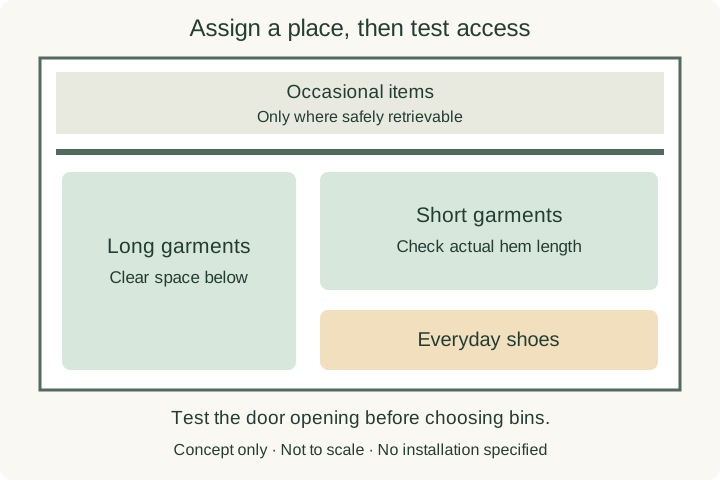
The example keeps the existing rod and shelf. The change is where clothes and shoes sit, so the owner can test the layout before spending money.
Choose between rearranging and installing storage
Try a version with no new installation first: move categories along the existing rod, reuse a suitable container, or relocate occasional pieces to storage you already have. Do not add a hanging organizer without checking the rod’s documented load limit; its contents add weight too.
If the access test still fails, write the specific problem before choosing hardware. “Folded shirts have no reachable shelf” is a more useful buying requirement than “need more storage.” A drawer unit helps only if it fits, opens, and leaves room for the clothes around it.
For an installation, confirm permission where required, including your rental agreement. Follow the storage manufacturer’s instructions for the wall type, fasteners, support spacing, and load limits. If you cannot identify the wall construction or a safe installation method, get qualified help. Do not infer capacity from how sturdy a shelf looks.
CPSC advises anchoring furniture with drawers, doors, and shelves to prevent tip-overs. A freestanding closet cabinet or dresser needs appropriate anchoring; putting heavy things at the bottom is not a substitute. If drilling is restricted, resolve the anchoring requirement before choosing furniture that needs it.
Close the section with an access test
Finish this section before opening another
If the section fails a test, move fewer things back into that exact location or change their placement. Do not open the next section to escape an unfinished decision. Stop with a usable closet, even if the rest still needs work.
For maintenance, repeat the access test when putting away laundry. If a category no longer returns easily, review that category’s location or contents before adding another container.
When the arrangement isn’t working
| Problem | What to change |
|---|---|
| The closet looks tidy, but getting dressed creates a pile. | Move the clothes used together into accessible positions; test removal and return. |
| Folded stacks fall over. | Reduce the stack or use a suitable existing drawer; do not squeeze in another layer. |
| A bin fits, but its lid cannot open. | Test it at the door opening; choose a different location or access style. |
| Long clothes cover the shoes. | Reserve clear space below long garments; put shoes below shorter pieces if access permits. |
| The bedroom becomes a sorting area. | Return the current section and clear the landing spot before removing anything else. |
| Shared sections keep changing. | Agree on boundaries and ask before relocating the other person’s clothes. |
Questions about small closets
Do I need to remove everything from a small closet?
No. Empty only the shelf or hanging section you can sort and put back before stopping. Keep the rest of the closet usable, and clear your temporary landing spot before opening another section. If you need to pause, return the clothes you are keeping and record any pending decisions in the worksheet.
What is a good closet organizer for a small closet?
Choose by the problem you recorded: shoe access, a folded-clothing home, or a reachable place for accessories. Bring the worksheet measurements and check opening clearance and documented load limits. An organizer that fits the empty space can still block the clothes around it.
How can I organize a narrow closet?
Check which part of the interior you can actually reach through the opening. Keep frequent-use pieces there, and avoid a deep container that must be fully removed to reach something behind it. If a proposed layout relies on an inaccessible corner, revise it before buying storage.
What are some clever hacks for organizing my closet?
Use a written section boundary and a landing spot that limits how much you can remove. Reuse containers only after testing their fit. A shortcut earns its place when you can retrieve and return clothes without creating another pile.
Sources
- Decluttering: Practical Tips for Home Organization, American Cleaning Institute. Accessed November 8, 2026.
Supports: Working in manageable areas, grouping similar items, and measuring both space and contents before buying containers. The worksheet, layout, and example are original editorial tools.
- Anchor It, U.S. Consumer Product Safety Commission. Accessed November 8, 2026.
Supports: Anchoring furniture with drawers, doors, and shelves to the wall to prevent tip-overs; not a source for universal shelf loads or closet dimensions.
- When and How to Clean and Disinfect Your Home, Centers for Disease Control and Prevention. Accessed November 8, 2026.
Supports: Use surface-appropriate cleaners according to labels; cleaning is usually sufficient; do not mix cleaning products, ventilate when using disinfectants, and keep chemicals away from children and pets.